
Dilbert comic strip and its creator; a sad ending for both and a personal remembrance

Scott Adams’s Dilbert comic strip was a ground-breaking classic that often told the uncomfortable truth about management and its ineptitude in dealing with its employees.
Scott Adams’s life, however, was an even more uncomfortable series of actions embracing racism, misogyny, and antisemitism.
Adams died this week at 68, and his obituaries ranged from a careful balance of these two facets of his life to barely mentioning his comments denigrating certain groups of people – comments that came to destroy his Dilbert business empire.
Dilbert, launched in 1989, was one of the first comic strips to portray real-people situations and conversations in an office environment.
It depicted humorous workplace situations with which everyday people could identify. Typically, management blundered along, taking advantage of its underappreciated and misunderstood workers. There was nothing like it on America’s newspaper comic pages when it was introduced.
Most comics usually provided a good laugh, but there were only a few that reflected real life situations.
Then came Dilbert.
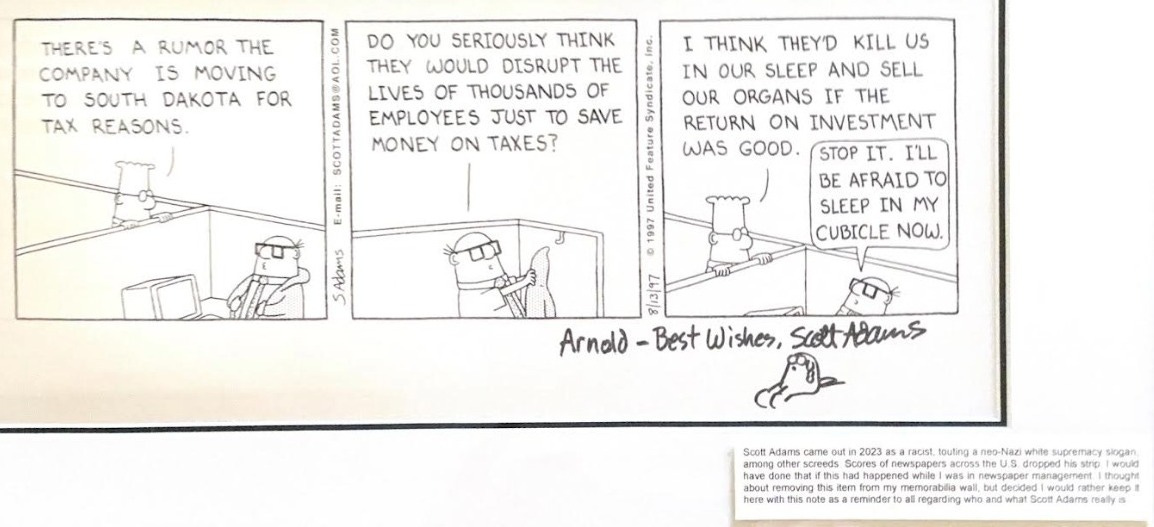
There was a particular Dilbert strip that both illustrates what I am talking about and to which I had a special connection.
The date of publication was August 13, 1997. I had been president and publisher of the Argus Leader in Sioux Falls, South Dakota, for almost a year.
In the mid 1990s, Sioux Falls and South Dakota had engineered a major corporate recruitment of an out-of-state business that stunned those who watched such things.
Citibank of New York decided to move its credit card business from New York City to Sioux Falls, South Dakota.
You read that right.
They built a building in Sioux Falls, transferred a few hundred employees to Sioux Falls from New York, and hired more people locally.
The lure was a state law in South Dakota that left credit card interest rates unregulated – whatever rate the card provider wanted to charge, could be charged. And if that was not enough, there was a bonus for coming to South Dakota: it was then and is now one of the handful of states – the number currently is nine – that does not have an income tax.
For Scott Adams, the situation probably was the stuff of which his dreams were made — a Dilbert comic strip theme basically gifted to him by a true story in South Dakota. He could tell the story and jump to a punch line all in three panels of the Dilbert strip. Oh boy, this will be fun, he must have thought.
In the first panel, one of Dilbert’s co-workers is talking to Dilbert: “There’s a rumor the company is moving to South Dakota for tax reasons.”
The second panel, Dilbert speaking now: “Do you seriously think they would disrupt the lives of thousands of employees just to save money on taxes?”
Third panel, Dilbert’s co-worker again: “I think they’d kill us in our sleep and sell our organs if the return on investment was good.”
I had been working in newspaper management for several years, and I knew a number of the sales reps for the syndicates that controlled the comic strips. The syndicates were the sales agents for comic strips and other nationally distributed newspaper features.
Dilbert, like all newspaper comics, was represented by a syndicate, which, in turn, sold the strips to individual newspapers for publication. At its peak, Dilbert appeared in more than 2,000 newspapers, and the annual revenue it produced for the syndicate and the creator would have had seven figures after the dollar sign.
After seeing the comic strip referencing Sioux Falls, I reached out to a sales rep I knew at the syndicate that represented Dilbert. In those years, it was not uncommon for the reps to arrange for their artists to provide signed copies of particular comic strips for their clients. It was a mutually beneficial arrangement – the signed strips were nice, and having them displayed in an office was good for the syndicate in terms of promoting sales and readership.
In this case, the sales rep provided a copy of the Dilbert strip that Scott Adams had signed to me: “Arnold – Best Wishes, Scott Adams,” followed by a small hand sketch of Dilbert. It was framed, and I hung it in my office in Sioux Falls, where, yes, it did attract attention from visitors.
Then, in 2023, it all came crashing down.
It started slowly with Adams’s comments disparaging women and Jews.
In a 2006 blog post, he questioned the Holocaust death toll of 6 million Jews, and wondered if it might have been a number that someone “pulled out of his ass.” The toll, while not an exact count, has been verified in multiple ways, including by a comparison of Jewish population totals in Europe and the world before and after World War II.
In a 2011 blog post, he said that society treats women differently for the same reasons children and the mentally disadvantaged are treated differently: “It’s just easier this way for everyone.”
The final blow came a few years ago when Adams zeroed in on racism in a podcast.
Focusing on a public opinion poll reporting that 53 percent of Black Americans agreed with the statement, “It’s OK to be white,” he said, “If nearly half of all Blacks are not OK with white people – according to this poll, not according to me, according to the poll – that’s a hate group . . .” He then added, “The best advice I would give white people is to get the hell away from Black people.”
Newspaper cancellation letters flooded the syndicate office. The strip soon was dropped from syndication.
I still had that signed Dilbert comic strip hanging in our Sioux Falls home, where we continue to live in retirement. I added a note at the bottom, saying that if I still were a newspaper executive, I, too, would have cancelled Dilbert.
The note continues: “I thought about removing this item from my memorabilia wall, but decided I would rather keep it here with this note as a reminder to all regarding who and what Scott Adams really is.”
All in all, a sad ending for Adams and Dilbert.
NOTE TO READERS: Arnold Garson: Second Thoughts is part of the Iowa Writers’ Collaborative, a unique assembly of more than 80 professional authors with Iowa roots. You can subscribe for free. Paid subscribers, however, are greatly appreciated. At $80 a year, it works out to about $1.50 a column. All proceeds will be used to support nonprofit organizations committed to maintaining local journalism or free speech.
Thank you for reminding me why I once laughed with Dilbert. This was our son Jeff’s favorite comic strip. I suspect that Jeff will be looking for Scott to ask him what in the hell happened to him.
First they came for the Sunday Doonesbury; then daily Dilbert--have not read the Register comic page since. Little known fact: Adams continued to publish two three-panel comics/day, one from ten years ago and one current, all acerbic and funny, available on his website for a few pennies/day. With increasing frequency he added a third--RRN (Robots Read News), scatological and often severely so, skewering the woke. Never sensed any racism. He was open about his cancer and published until two days before he died.