
Nuremberg: where the seeds of the Holocaust were planted; also where Germany's leading Nazis were tried
A new movie, Nuremberg, recalls the trials

A new movie, entitled, simply, Nuremberg, depicts the complicated story of how the U.S. and its World War II Allies set out after the war to try top-level Nazi officials for crimes against peace, crimes against humanity, and war crimes.
The Nuremberg Trials opened 80 years ago this month in Nuremberg, Germany. A tribunal of four judges representing the allied nations – Great Britain, France, and Russia, in addition to the U.S. – sat through 216 court sessions extending over more than 10 months.
In the end, 21 Nazi officials were convicted – seven of them sentenced to prison terms of 10 years to life, and 14 of them sentenced to death by hanging.
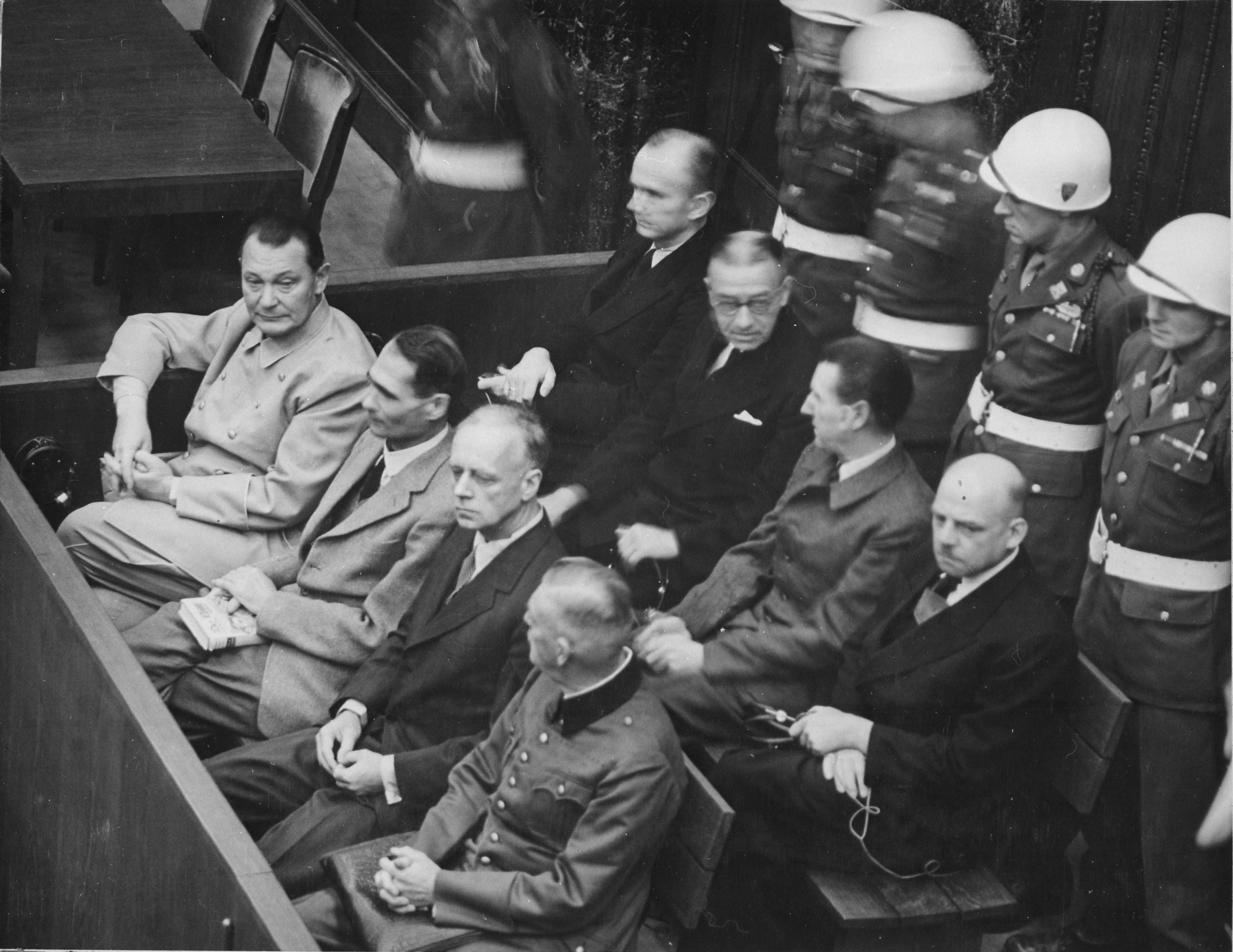
Adolph Hitler committed suicide at the end of April 1945, and Germany surrendered about a week later. Hitler’s successor, Hermann Goering, thus became the top Nazi to be charged and tried at Nuremberg. Goering also is a major focus of the new movie and was among those sentenced to death by the judicial tribunal. He took his own life, however, by swallowing a cyanide capsule before he could be executed.
(How did he get the cyanide capsule? An American guard at Nuremberg disclosed in 2005 that he unknowingly provided the cyanide after a German girl duped him into smuggling a fountain pen into Goering’s cell. The pen contained what the guard thought was medicine the prisoner needed.)
The City of Nuremberg was not an accidental location for the trials stemming from Germany’s brutal slaughter of 6 million Jews during the war – an average of 2,500 Jews slain on every one of the 2,441 days the war lasted. Nuremberg was one of the earliest sizable cities in the world to begin murdering its Jewish residents. It was also the city where the seeds for the Holocaust were planted by top Nazi officials.
The recorded history of Nuremberg as a focal point of antisemitism in the world began on August 1, 1298, when 698 Jews who lived there, including entire families, were murdered because . . . Well, just because. The city never was far away from its next strike of unprovoked antisemitism against its Jewish residents after that.
And so it was, in the fall of 1935, not quite three years after the Nazi Party had taken control of Germany, that the Party staged a weekend rally in Nuremberg, at which it enacted a profligate and onerous pair of laws that would set the stage for the Holocaust.
The storyline in the movie Nuremberg is compelling. But it may be even more important to remember the events in Nuremberg that put Germany on its path to murdering millions of Jews of central and eastern Europe.
The process had its roots in the action by Germany’s national legislative body as it met in conjunction with the Nazi Party rally over the weekend of September 13-15, 1935. That Sunday, the new laws, known as the Nuremberg Race Laws, of course, were announced to a cheering, screaming, applauding, saluting crowd of supporters.
Some parts of the world, however, barely noticed what had happened.
It was another law enacted at the same time and announced on that Sunday that got most of the attention, at least in New York, America’s most Jewish city.
“REICH ADOPTS SWASTIKA AS OFFICIAL FLAG,” The Times stated in its top headline of two columns on Page 1 the next morning. OK, but for a top headline, a bit more clarity would have been nice. SWASTIKA IS GERMANY’S NEW NATIONAL FLAG might have been more precise.
The Nuremberg Race Laws were announced by The Times in a one-column sub-headline on the story: “ANTI-JEWISH LAWS PASSED.” Vague, but at least it made the top half of Page 1.
(The Des Moines Register did manage to get the news in the right order with a headline stretching the full width of Page 1 – “HITLER OUTLAWS GERMAN JEWRY.” A one-column subhead focused on the other part of the story, “SETS UP NAZI SWASTIKA AS OFFICIAL FLAG.”)
The Times did get around to explaining that the swastika flag and the race laws were closely linked, but only the most attentive readers that day would find this news – in a bottom paragraph on an inside page. Stay tuned.
The first of the two Nuremberg Laws defined Jews based on their ancestry without regard to what religion, if any, they practiced. For the first time in history, Jews would be discriminated against based on who their parents were, not based on what they believed.
In addition, Jews no longer would be allowed to marry or have sexual relations with anyone who was Aryan by birth. Pre-existing marriages between Jews and Aryans were declared invalid. Another provision forbade Jews from employing Aryan women under age 45 as household servants. The crowd laughed when it was announced. Punishment for violating these restrictions would be imprisonment with hard labor.
The second Nuremberg Law provided that Jews no longer were German citizens – meaning that they no longer enjoyed the rights of citizenship under German law.
The Nuremberg Laws became effective on January 1, 1936. By that time, the laws also were expanded to apply to groups labeled as Gypsies and Negroes.
Ultimately, the Nuremberg Laws turned out to be stepping stones to more anti-Semitic restrictions in 1937 and ’38. Jews were required to register their property. Aryan-owned businesses were required to dismiss Jewish workers and managers. Jewish business owners were required to sell out to Aryans at extremely low prices determined by the Reich. Jewish lawyers were ordered to stop practicing law, and Jewish doctors were limited to treating only Jewish patients. The idea was to force the country’s Jewish population into poverty.
For Jews who did not have Jewish-sounding names, the Nazis added middle names on their identification cards – Israel for all men, Sara for all women. It needed to be easy for officials to enforce the new laws.
But back to what played as the big news on Monday, September 16, 1935: The new flag.
For those who read down to the fortieth paragraph or so, the last paragraph of The Times’s coverage that day at the very bottom of Page 11, Goering, president of the Reichstag, made it clear what path the Nazis were on.
The new flag, he said, “was the symbol of racial purity, too. Therefore, no Jew may raise this holy symbol.”
And so, in 1937 and 1938, about a year after the oppressive restrictions were implemented, it began: The Holocaust, the murder of one-third of the world’s Jewish population.
By 1941, Hitler and his commanding officers realized that the process was moving along more slowly than they wanted. They built the world’s first industrialized facility designed for the purpose of mass murder and the efficient disposal of bodies. It was the model for multiple additional death facilities.
The Nuremberg Trials were a conclusion of sorts to the effort led by about two dozen German men to end Jewish life on earth.
Sadly, the conclusion came at the wrong end of the years’ long process.
Note: Parts of this column originally appeared in a Facebook post I wrote in 2020.
NOTE TO READERS: Arnold Garson: Second Thoughts is part of the Iowa Writers’ Collaborative, a unique assembly of more than 80 professional authors with Iowa roots. You can subscribe for free. Paid subscribers, however, are greatly appreciated. At $80 a year, it works out to about $1.50 a column. All proceeds will be used to support nonprofit organizations committed to maintaining local journalism and free speech.
So far as I know, the number of non-Jews sent to the camps for idealogical and racial reasons was about 500,000, and most of them died. There were millions of others killed by the Nazis outside the camps, including 3 million Soviet POWs, who died in prison settings of starvation. The Nuremberg Trials were the only war trials, again, so far as I know.
Thanks for reading, Tim.